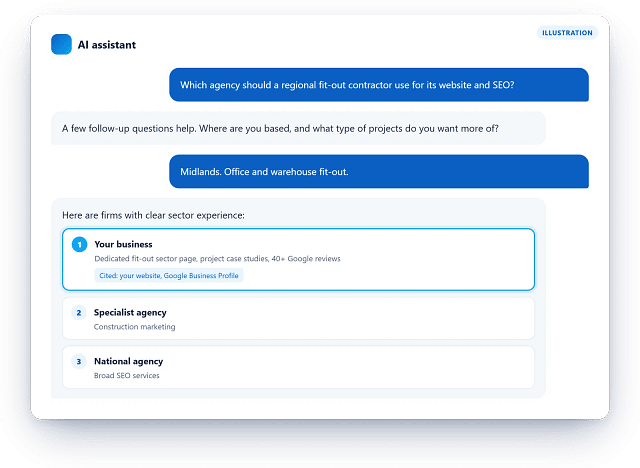


Ask them. Type the questions your customers would type into ChatGPT, Perplexity and Google’s AI answers, and see whether your business comes back. The trick is asking the right questions, asking them several times, and reading the answers properly. This guide shows you how, in about half an hour.
Why is it worth checking?
A growing share of buyers now start with an AI assistant rather than a search results page. The assistant asks a couple of follow-up questions, then names two or three businesses. Most people take that answer and move on.
If you are not in it, you are not in the running for that buyer, and nothing in your analytics will tell you. There is no impression count for an answer you were left out of. The only way to know is to look.
Which questions should I ask?
Ask the questions a customer asks, not your company name. Searching for your own name tells you whether the assistant knows you exist. It tells you nothing about whether it recommends you.
Write down eight to twelve questions in three groups:
- Problem questions. “Who can fit out a 20,000 sq ft warehouse office in the Midlands?” “I need a solicitor for a house sale in Southampton.”
- Comparison questions. “Best commercial fit-out contractors in Leicestershire.” “Which family law firms in Hampshire have good reviews?”
- Follow-up questions. When the assistant asks you something back, such as your budget or timescale, answer it the way a real buyer would and see who it names next.
Include your town or county in some questions and leave it out of others. Local and national questions often give very different answers.
How do I run the test properly?
- Use a fresh session. Log out, or use a private window, so the assistant is not drawing on your own history.
- Try at least three assistants: ChatGPT, Perplexity and Google’s AI Mode or AI Overviews. They search and weigh sources differently.
- Ask each question three times. Answers vary from one attempt to the next. Being named once in three is a very different position from being named every time.
- Record what you see. For each question, note who was named, in what order, and which sources were cited. A simple spreadsheet is enough.
What do the results mean?
You are named consistently
Good. Look at which sources the assistant cites when it names you, because those are the pages holding your position up. Keep them accurate and keep adding to them.
You are named sometimes
The assistant knows about you but is not confident. That usually means your information is thin or inconsistent somewhere: a vague service page, an old address on a directory, or too few recent reviews. This is the most fixable position to be in.
You are never named, but competitors are
Look closely at the businesses that are named and the sources cited for them. You will usually find they have a clear page for the exact service asked about, more reviews, or mentions on industry and directory sites that you do not have.
Nobody local is named
The assistant could not find a business it trusts for that question, so it falls back to national names or generic advice. That is an open goal for whoever sorts it out first.
What should I do about it?
Start with the basics, because they move the most:
- Make sure each service you want to be recommended for has its own clear page that says what you do, where, and for whom.
- Make your business name, address, phone number and description identical everywhere: website, Google Business Profile, directories and social profiles.
- Ask happy customers for reviews regularly, and reply to them.
- Check that your website’s text is readable without JavaScript. Many AI crawlers do not run it.
We explain the reasons behind each of these in how ChatGPT and Perplexity decide which businesses to recommend.
Common questions
Monthly is enough for most businesses. Use the same set of questions each time so you can compare like with like and see whether changes you make are working.
AI assistants generate each answer fresh and often run a new search. That is why you should ask each question several times and look at how often you are named, not at a single answer.
Not really. It shows whether the assistant knows you exist, but buyers do not search for you by name before they know you. Test the questions customers actually ask.
Yes. Our Organic Visibility Audit runs your real buying questions across ChatGPT, Perplexity and Google’s AI, records what comes back, and explains what to fix first.
Want someone to run this properly and tell you what to fix? Get in touch and we will check what ChatGPT, Perplexity and Google’s AI say about your business, or read about our Organic Visibility Audit.