
AI search optimisation

Get recommended by ChatGPT, Google AI and Perplexity

More buyers now ask an AI assistant for a recommendation before they search. We make sure the evidence about your business is clear, consistent and easy to quote, then track whether you are being named, month by month.
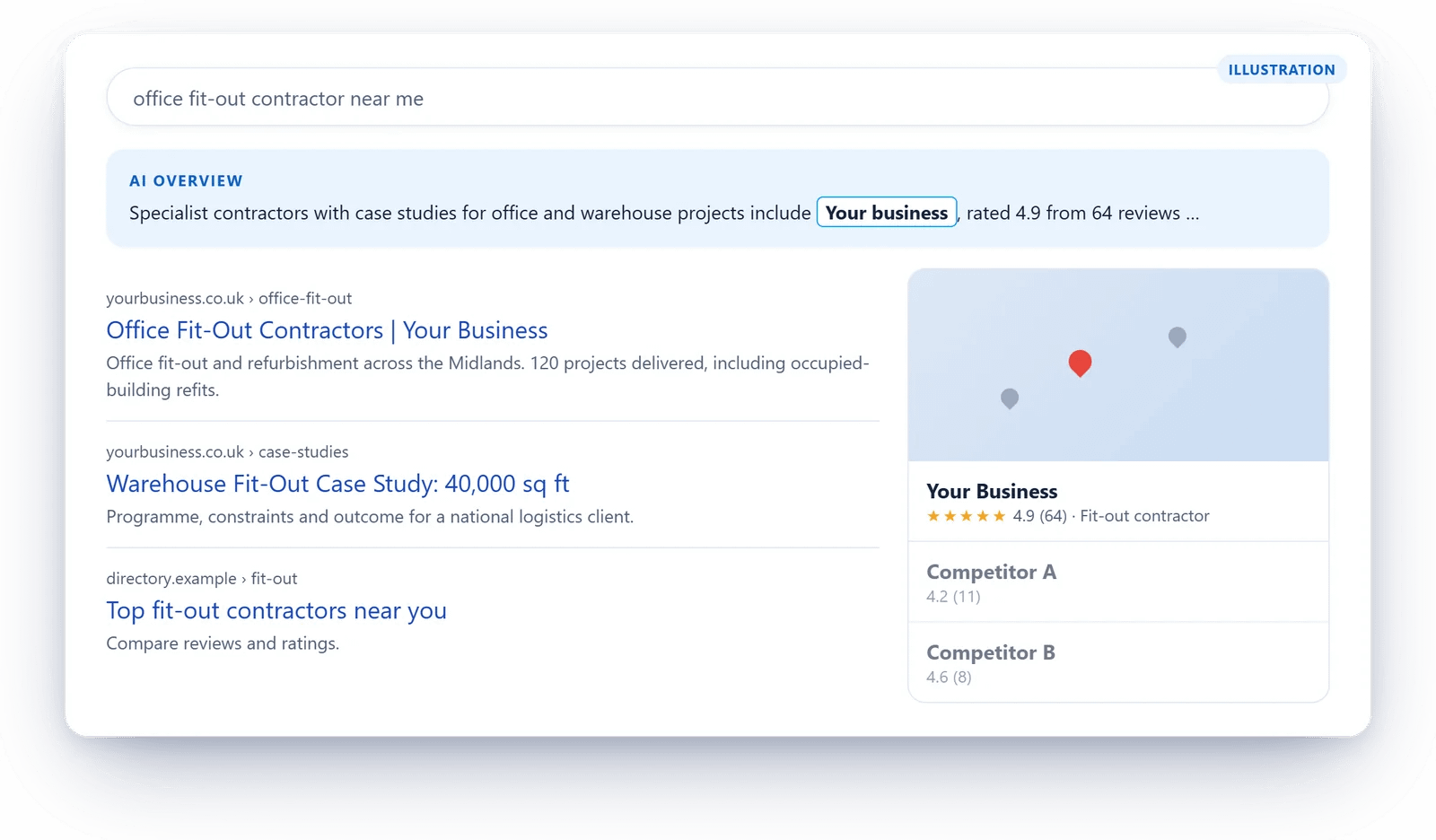
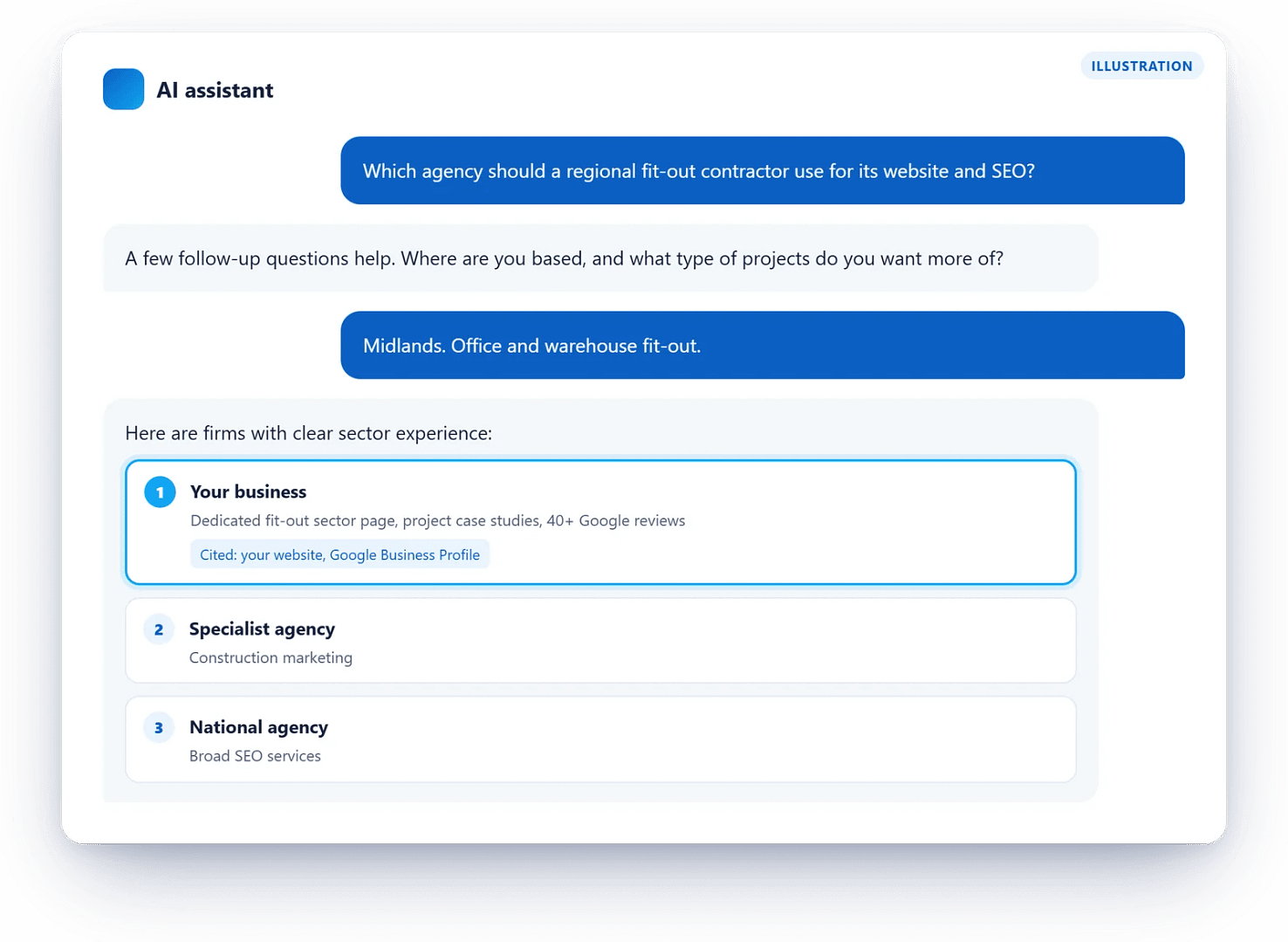
Illustration of search results with an AI overview and map pack

5.0 ★Google rating from 15 reviews

50+websites we manage

40businesses on monthly plans

2019trading since. Based on the Isle of Wight, working UK-wide

How AI assistants choose which businesses to name

Ask ChatGPT, Perplexity or Google’s AI Mode to recommend a business and you rarely get one answer straight away. The assistant asks a follow-up question. What industry are you in? Where are you based? What is your budget? Then it names a handful of businesses that match.

Here is a real example. In October 2026 we asked Google AI Mode to recommend a UK agency for ongoing SEO and website care. It named four national agencies, quoted typical UK retainers of £1,500 to £5,000+ a month, then asked which industry we were in. That last question is where smaller firms have their chance.

For a broad question, the answer usually goes to the biggest national names, because they appear in awards, rankings and “best of” lists. Once the question narrows to a sector, a location or a price range, smaller specialists get named. They get named because they have a page that matches the follow-up exactly, and outside evidence that backs it up.

To choose, the assistant reads the web. It looks at your website, your Google Business Profile, your reviews, the directories you are listed in and what other sites say about you. If those sources agree with each other and answer the question clearly, you have a chance of being named. If they are thin, vague or contradict each other, someone else gets the mention.

Illustration of an AI assistant recommending a business after follow-up questions

What AI assistants look for

There is no secret switch. These are the signals that show up again and again when we test real prompts.

A page that answers the follow-up

If the assistant asks about industry, location or budget, it needs a page on your site that answers that question directly. A sector page, a location page, a service page with a price range.

Reviews

Reviews are evidence to AI as well as to people. Assistants read review counts and ratings when choosing between similar businesses, and quote what reviewers say.

Directories and listings

Assistants pull from business directories, industry listings and review platforms. Being listed accurately in the right ones gives them a second source to confirm you exist and do what you say.

Consistent business details

Your name, address, phone number, founding year, people and services should match everywhere: your website, Google Business Profile, LinkedIn, Companies House and directories. Contradictions make an assistant less confident about you.

Clear service and pricing pages

Plain statements of who you work with, what you do, how it works and roughly what it costs. Assistants quote clear facts. They skip pages full of slogans.

Case studies with numbers

AI engines quote figures. A case study that names the client, the problem and a measurable result is far more likely to be lifted into an answer than a gallery of screenshots.

What we do about it

AI search optimisation is part of every Organic Presence plan. This is the order we work in.

1

Test where you stand

We run a set of real questions your customers might ask, across Google AI Overviews, AI Mode, ChatGPT and Perplexity. We record who gets named, which sources are cited, and what the assistants say about you, if anything.

2

Fix your business details

We make your name, address, phone number, founding date and services consistent across your website, Google Business Profile, LinkedIn and the directories that matter in your sector. We add structured data so machines can read the same facts.

3

Build the pages that answer follow-ups

Service pages with clear scope and price ranges. Sector or location pages where you have real experience. FAQ answers written so an assistant can quote them directly.

4

Turn your work into evidence

We help you write case studies with named clients and real numbers, and set up a simple routine for asking happy customers for reviews.

5

Measure and adjust

We re-run the same prompts every month, report the results and adjust the plan based on what is moving.

Example Organic Presence monthly report with search clicks, enquiries, AI mentions and reviews

How we measure it

We agree a fixed set of prompts with you at the start, a fixed set of questions a real customer would ask. For example, “Which firm should a regional business use for its commercial office fit-out?” or “Recommend a solicitor in Southampton for a commercial lease.” The set stays the same, so the results are comparable month to month.

Every month we run those prompts across Google AI Overviews, Google AI Mode, ChatGPT and Perplexity. We record whether you are named, where you appear in the answer, which competitors are named alongside you, and which sources the assistant cites.

Your monthly report shows the results in a simple table, next to your normal search figures. When a source keeps being cited, such as a particular directory or a competitor’s case study, that tells us where to focus next.

What no one can promise

No one can guarantee that ChatGPT, Google or Perplexity will recommend your business. Anyone who promises that is guessing. The assistants change how they work often, give different answers to the same question on different days, and tailor answers to the person asking.

What we can do is make sure the evidence about your business is clear, consistent and easy to find, so you have the best chance of being named when the question fits. We then measure honestly and tell you what is and isn’t moving.

Some things take time. Reviews build up gradually. Directories update on their own schedules. Case studies need real results to write about. That is why AI search optimisation works best as part of a monthly plan and poorly as a one-off job.

You may also hear about llms.txt, a file some sites publish to guide AI tools. No major AI engine has confirmed that it reads it. We keep one up to date for clients as a small extra, and we don’t treat it as a strategy.

We also don’t chase tricks. Hidden text, fake reviews and mass-produced pages written only for machines can backfire, and they put your reputation with real customers at risk.

Why it sits inside Organic Presence

Most of what makes an AI assistant trust you also helps you rank on Google: clear pages, good reviews, accurate listings and a fast, well-built website. Running them separately means paying twice for overlapping work.

So we run AI search optimisation as one of six areas covered by Organic Presence, alongside search, content, Google Business Profile and reviews, technical care and monthly reporting. One team, one plan, one report.

Further reading

How do ChatGPT and Perplexity decide which businesses to recommend? A plain-English guide to how AI assistants find, check and choose businesses, and what makes yours citable.

AI search questions

Can’t see your question? Call 01983 216222 or send us a message.

AI search optimisation is the work of making your business easy for AI assistants such as ChatGPT, Perplexity and Google AI Mode to understand, trust and recommend. It covers consistent business details, clear service and pricing pages, reviews, directory listings and case studies with real numbers. Some people call it GEO (generative engine optimisation) or AEO (answer engine optimisation).

AI assistants usually ask a follow-up question about industry, location or budget, then name businesses that match. To choose, they read the web: your website, your Google Business Profile, reviews, directories and what other sites say about you. Businesses with clear, consistent and well-supported information are more likely to be named than those with vague or contradictory details.

No. No one can guarantee that ChatGPT, Google AI or Perplexity will name a particular business. The assistants change often and give different answers to the same question. What Four Point Digital does is improve the evidence those assistants rely on, then track a fixed set of prompts every month so you can see honestly whether you are being named.

We agree a fixed set of prompts that real customers might ask, then run them every month across Google AI Overviews, Google AI Mode, ChatGPT and Perplexity. We record whether you are named, where you appear, which competitors are named and which sources are cited. Because the prompts stay the same, results can be compared month to month.

It overlaps heavily. SEO aims to rank your pages in Google’s list of links. AI search optimisation aims to get your business named inside an AI answer. Both rely on clear pages, a healthy website and a good reputation. AI search puts extra weight on reviews, directory listings, consistent business details and quotable facts, which is why Organic Presence covers both together.

Four Point Digital includes AI search optimisation in every Organic Presence plan. Plans start from £395 a month excluding VAT, on a short minimum term. The number of prompts we track and the amount of content we produce depends on the plan. We confirm the price after an Organic Presence Review.

See what AI says about you today

Book an Organic Presence Review and we’ll test real customer questions across ChatGPT, Perplexity and Google’s AI, then show you what we would fix first. Or read how Organic Presence works.