

llms.txt is a proposed standard: a plain text file at the root of your website that summarises who you are and links to your most important pages, written for AI tools to read. It is cheap and harmless to add. But adoption by the big AI assistants is limited, so treat it as insurance rather than a way to get recommended.
Where did llms.txt come from?
It was proposed in September 2024 by Jeremy Howard of Answer.AI. The idea is simple. Websites are full of navigation, adverts, cookie banners and scripts. A large language model trying to understand a site has to dig through all of that. An llms.txt file gives it a clean summary instead, in a predictable place: yourdomain.co.uk/llms.txt.
The format is ordinary Markdown: a heading with your name, a short summary, then sections listing key pages with a line about each.
Who actually uses it?
This is where honesty matters, because a lot of what is written about llms.txt oversells it.
It has been picked up quickly by software companies, particularly for developer documentation, and many documentation platforms now generate one automatically. Some AI coding tools read these files when pointed at them.
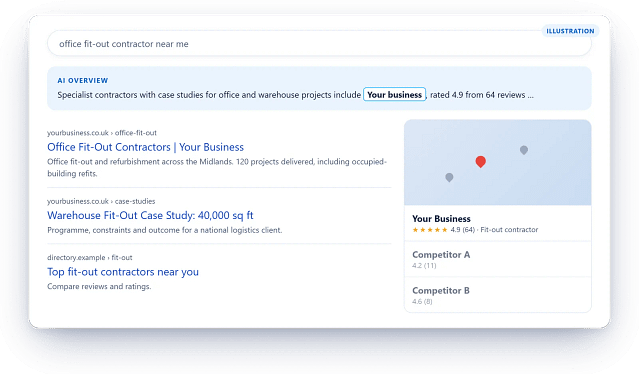
For general web search, it is a different story. At the time of writing, none of the major AI assistants has publicly committed to using llms.txt when deciding which businesses to recommend. Their crawlers may fetch it, but there is no evidence that having one moves you into an answer.
What can it not do?
- It does not control which AI crawlers can access your site. That is robots.txt.
- It does not override what your actual pages say. If your service pages are vague, a tidy summary will not fix that.
- It is not a ranking factor that anyone has confirmed, for Google or for AI assistants.
Should I add one?
If it takes you or your developer half an hour, yes. It costs nothing, it does no harm, and it forces a useful exercise: writing down in plain language what you do, for whom, where, and which pages prove it. That exercise is valuable even if no machine ever reads the file.
We run one on our own site. It lists our services and prices, the sectors we work in, our named clients and our key pages.
How do I add one?
- Write a short Markdown file: a top-level heading with your business name, a one-paragraph summary, then sections such as Services, Clients and Key pages, each with links.
- Keep the facts identical to your website, Google Business Profile and directory listings.
- Publish it at the root of your domain as llms.txt. On WordPress this can be done with a small snippet or a plugin.
- Update it whenever your services, prices or key pages change.
What matters more than llms.txt?
Everything AI assistants demonstrably rely on today:
- Pages whose text is readable without running JavaScript. See why your JavaScript website might be invisible to AI assistants.
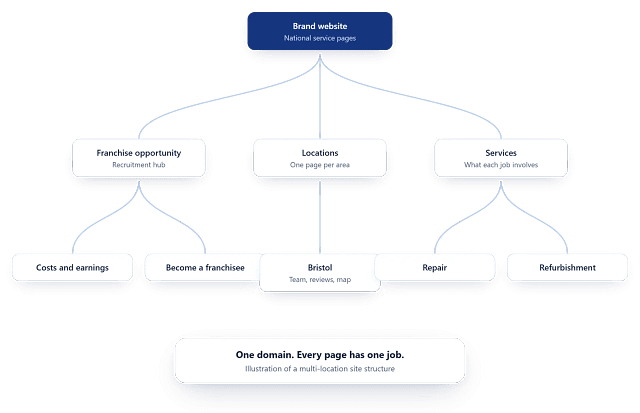
- Clear, specific pages for each service and location.
- Consistent business details everywhere they appear.
- Accurate structured data. See does schema markup matter for AI search?
- Genuine reviews and mentions on other credible websites.
Common questions
No. robots.txt tells crawlers which parts of your site they may access. llms.txt is a summary of your site’s content for AI tools. You can have both, and they do different jobs.
There is no evidence that it does. Treat it as a cheap extra. Being readable, specific, consistent and well reviewed matters far more.
Some sites publish a second file containing the full text of key pages. It is optional, and for most small business websites a short llms.txt is enough.
Want to know what actually moves AI visibility for your business? Get in touch, or read about our Organic Visibility Audit.